
"The next revolution in grading is not about rejection, but about insight"
"For years, the sector has invested millions in removing poor-quality products. The next challenge is to understand the good ones," says Rutger Keurhorst. In the opinion piece below, he explains:
Over the past ten years, the onion and potato industry has made enormous progress in automation. Driven by rising labor costs, a structural labor shortage, and increasingly stringent quality requirements, packers around the world have invested heavily in optical grading technology. In particular, the introduction of pre-grading systems that are relatively easy to implement has enabled many companies to replace much of their manual quality control with cameras and software. For many businesses, this has been a major step forward, delivering more consistent product quality, lower labor costs, and higher processing capacity.

From rejection to insight
Now that this first wave of automation is maturing, a new trend is emerging within the sector. The question is no longer simply how effectively a machine can reject products, but how much data, and therefore knowledge, a grading system actually generates. Although modern systems are becoming increasingly capable of detecting defects, many processors still gain only limited insight into the quality of the millions of onions and potatoes that pass through their systems each year. They know how many products are rejected, but often not exactly why. They know the end result, but not always the underlying causes.
This is remarkable because every rejected onion or potato represents a valuable data point. Behind every defect lies information about growing conditions, storage quality, logistics, supplier performance, or seasonal influences. If that information is not captured, a substantial part of the potential value of automation is lost. The system may grade the produce, but it does not generate knowledge from it. It is precisely here that a major shift now appears to be taking place. More and more companies are realizing that the economic value of a grading line is determined not only by the amount of labor it saves, but also by the insight it provides. In other words, many companies have until now underestimated the potential of making intelligent use of data generated during the grading process.
From grading to measuring
This development is being driven by technologies capable of fully analyzing individual products. When every onion or potato is assessed individually for weight, size, shape, external quality, and, where possible, even internal quality, a fundamentally different picture of the product flow emerges. The grading line is transformed from a machine that separates products into a system that measures quality. In other words, it becomes a new quality assurance system that inspects 100% of onions and potatoes non-destructively and with a high degree of reliability, rather than relying on sample-based quality control. This makes it possible to guarantee the quality of an entire harvest while preventing or minimizing waste. It also creates new opportunities to identify differences between growers, plots, storage facilities, and markets. In addition, it makes quality trends throughout the season measurable rather than merely assumed.
Bringing the inside into view
Many experts expect a major breakthrough in the coming years, particularly in the field of internal quality assessment. Historically, the inside of an onion or potato remained largely hidden until the product was cut open or consumed. As a result, quality issues often only became apparent after economic losses had already occurred. Technologies that detect internal defects at an earlier stage make it possible to shift quality management from a reactive to a predictive approach. This not only provides greater control over product quality, but also over yield, customer satisfaction, and risk management.
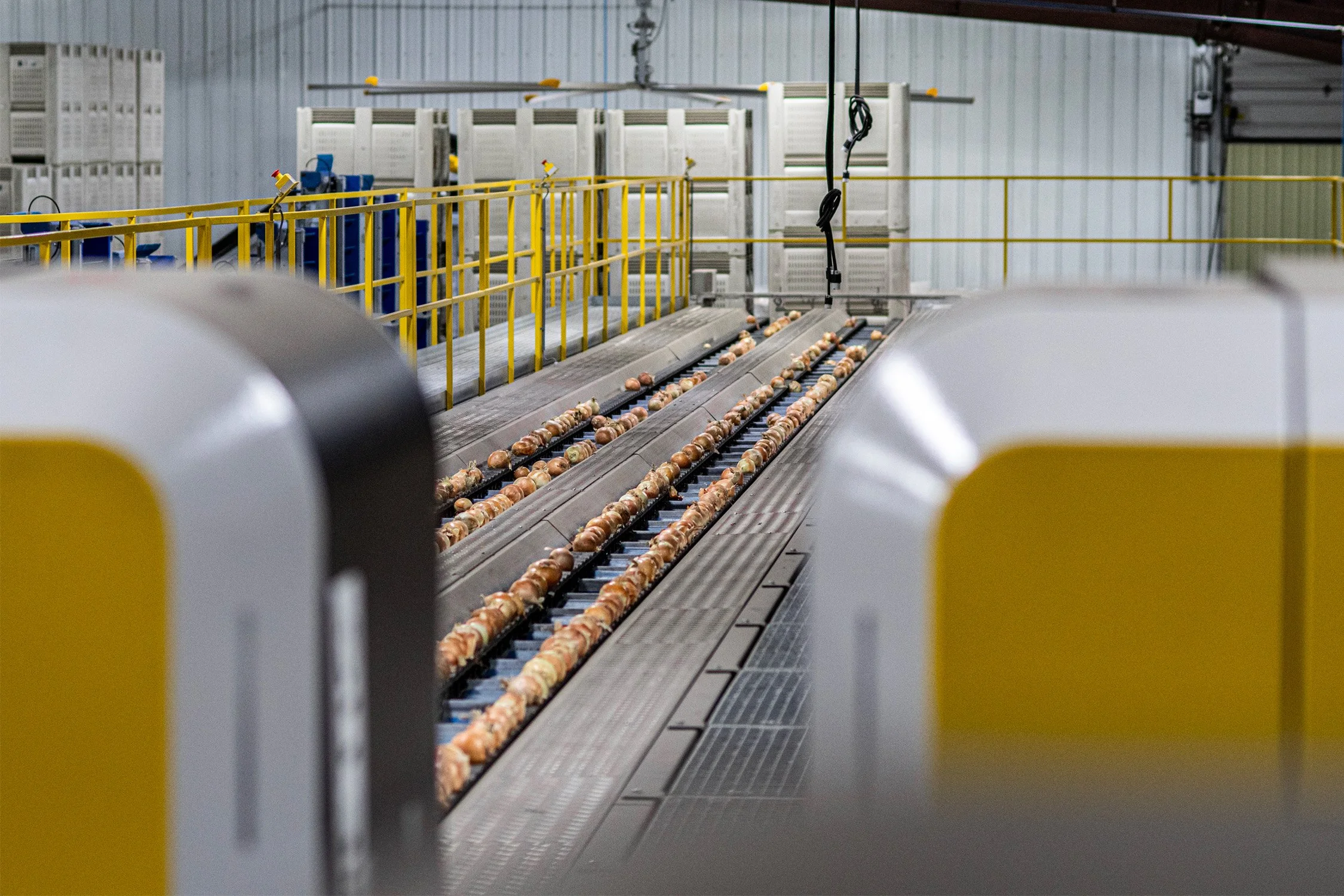
Insight has no limit
Consequently, the nature of the question being asked in boardrooms is gradually changing. Whereas investment decisions were traditionally evaluated in terms of labor savings, the focus is shifting to a different KPI: how much better do we understand our product as a result of this investment? That may seem like a subtle distinction, but the impact is significant. Labor savings ultimately have a natural limit. Insight, however, has no such limit. Companies that better understand their product flows can manage quality, storage, logistics, market segmentation, and yield with greater precision.
The agri-food industry therefore finds itself at an interesting tipping point. Recent years have been dominated by automation. The coming years are likely to focus primarily on making intelligent use of data from the grading process and, in doing so, building fundamental knowledge. Not grading faster, but managing more intelligently. No longer simply rejecting products, but understanding them better.
Perhaps the most important question for the coming years is therefore not how many tons of produce a grading line can process, but how much knowledge it has generated after processing those tons. Tomorrow’s winners will not be the organizations that process the greatest volume of produce, but the companies that learn the most from every product they process.